

Selection of the most appropriate virtualization platform is an extremely important step that will affect the whole operation of your company’s infrastructure. Regardless of whether you run a VPS hosting business, deploy enterprise applications, or even set up a development environment, choosing between OpenVZ and Proxmox VE can make a significant difference in efficiency and functionality.
For any engineer or systems administrator responsible for designing a scalable, reliable server infrastructure, the choice of a virtualization platform is fundamental. It defines your operational limit, your deployment speed, and your long-term maintenance costs. When the debate comes down to OpenVZ vs Proxmox, you are comparing two fundamentally different philosophies of server isolation. This is not a simple feature comparison; it’s a choice between the ease of containerization and the deep technical control offered by a hypervisor.
Before evaluating virtualization technology, remember the foundational rule: the host and underlying hardware must be fully trusted, regardless of the hypervisor you choose. If you are strategically initiating virtualization or require a stable foundation, consider partnering with a host that delivers proven infrastructure capability. For instance, reliable web hosting is the mandatory technical prerequisite that allows your chosen virtualization layer to execute without flaw from day one.
What Is OpenVZ?
OpenVZ is an open-source, container-based virtualization technology that allows multiple isolated environments (called containers or VPS) to run on a single physical server. Instead of creating full virtual machines, OpenVZ uses operating system–level virtualization where all containers share the same Linux kernel. This makes it extremely lightweight and efficient compared to traditional virtualization methods.
Each container in OpenVZ functions like an independent server with its own file system, users, processes, and network configuration. However, since they all rely on the host system’s kernel, they are faster to deploy and consume fewer resources. This efficiency is why OpenVZ is widely used by VPS hosting providers for high-density and low-cost hosting solutions.
One of the biggest advantages of OpenVZ is its performance and cost-effectiveness. It allows providers to run many VPS instances on a single machine with minimal overhead. Containers can be created quickly using templates, and they start almost instantly. However, this architecture also introduces limitations, such as being restricted to Linux-based systems and not supporting custom kernels.
What Is Proxmox VE?
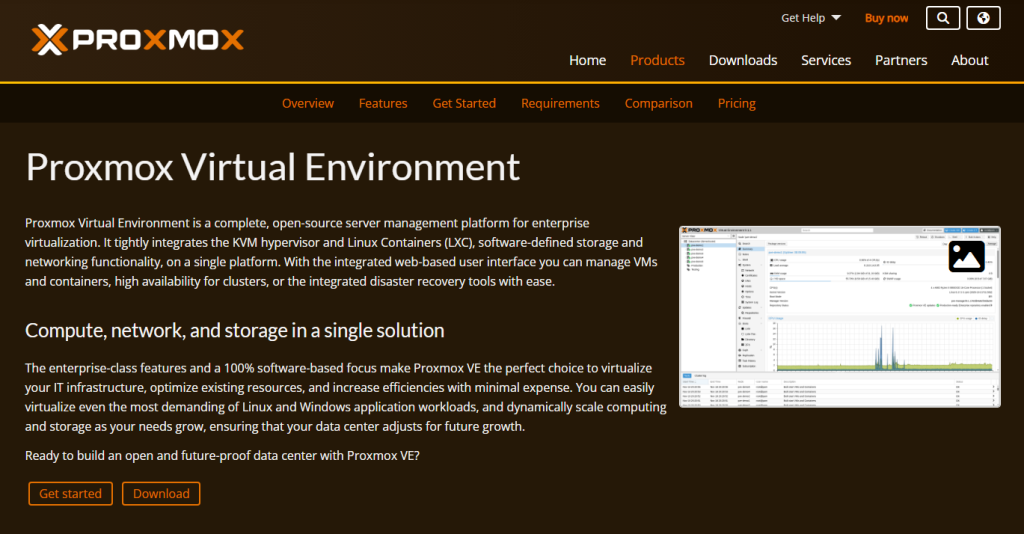
Proxmox VE (Virtual Environment) is an open-source server virtualization management platform designed to run and manage both virtual machines (VMs) and containers on a single system. It is built on top of Debian Linux and integrates two powerful technologies: KVM (Kernel-based Virtual Machine) for full virtualization and LXC (Linux Containers) for lightweight container-based virtualization.
One of the key strengths of Proxmox VE is its web-based management interface, which allows users to easily create, configure, and monitor virtual machines without needing advanced command-line knowledge. Through this dashboard, administrators can manage CPU, RAM, storage, networking, and backups in a centralized way. It also supports advanced features like live migration, high availability (HA) clustering, and snapshot backups, making it suitable for production environments.
Proxmox VE is widely used in both enterprise data centers and small IT setups because it offers a balance between simplicity and powerful infrastructure control. With KVM, users can run multiple operating systems like Linux and Windows with strong isolation, while LXC provides lightweight containers for efficient resource usage. It also supports various storage backends such as ZFS, Ceph, and LVM, giving users flexibility in designing scalable storage systems.
OpenVZ vs Proxmox VE: Key Differences
Proxmox VE delivers a more advanced and flexible virtualization environment with strong isolation, multi-OS support, and enterprise features. It is ideal for scalable, secure infrastructures, while OpenVZ remains better suited for simple, lightweight Linux-based hosting. There is a table between OpenVZ and Proxmox VE.
| Feature | OpenVZ | Proxmox VE |
| Virtualization | Uses container-based virtualization where all instances share the same Linux kernel. Lightweight and fast, but limited in flexibility. | Hybrid virtualization using KVM (full VMs) + LXC containers. Offers both lightweight containers and full isolation with VMs. |
| OS Support | Supports only Linux distributions due to shared kernel architecture. | Supports multiple operating systems including Linux, Windows, BSD, and others via KVM. |
| Performance | Near-native performance with minimal overhead, ideal for high-density environments. | High performance, but slightly heavier due to full virtualization in KVM. Still optimized for modern workloads. |
| Isolation | Moderate isolation; containers are separated but share the same kernel, which may pose security risks. | Strong isolation; each VM has its own kernel, ensuring better security and stability. |
| Scalability | Highly scalable for Linux container environments, especially in VPS hosting. | Very high scalability with clustering, multi-node management, and enterprise-level features. |
| Backup & Recovery | Limited native backup options; often depends on external tools. | Built-in backup system with scheduling, snapshots, and easy restore options. |
| High Availability (HA) | Not natively supported; requires manual configuration. | Built-in HA clustering for automatic failover and uptime reliability. |
| Networking | Basic networking features, suitable for simple setups. | Advanced networking with VLANs, bridges, SDN, and firewall integration. |
| Storage Support | Limited storage flexibility. | Supports multiple storage types (ZFS, Ceph, NFS, iSCSI, local storage). |
| Use Case | Best for lightweight VPS hosting and simple Linux workloads. | Ideal for enterprise, cloud infrastructure, labs, and mixed workloads. |
Understanding the Core Difference: Containers vs. Hypervisors
The fundamental distinction between OpenVZ and Proxmox is the method used for core resource isolation. A mistake here immediately destroys performance or creates massive security loopholes at the core.
OpenVZ: Operating System-Level Virtualization
OpenVZ uses container-based (OS-level) virtualization, where multiple isolated containers run on a single Linux kernel. Each container acts like a separate server but shares the host system’s core resources, making it lightweight and fast.
Pros:
- Very low resource usage with near-native performance
- Fast deployment and instant startup
- Cost-effective for high-density VPS hosting
- Simple management with templates
Cons:
- Limited to Linux-based operating systems only
- No kernel customization or advanced system control
- Weaker isolation compared to full virtualization
- Kernel-level issues can affect all containers
Best For:
OpenVZ is best for budget VPS hosting, lightweight applications, development environments, and Linux-only workloads where performance and cost-efficiency are priorities.
Proxmox VE: The Complete Virtual Environment
Proxmox VE combines KVM (full virtualization) and LXC (container virtualization) in one platform. It allows users to run fully independent virtual machines with their own kernels, as well as lightweight containers.
Pros:
- Supports multiple operating systems (Linux, Windows, BSD)
- Strong isolation and better security with KVM
- Built-in web interface for easy management
- Advanced features like backups, snapshots, clustering, and high availability
- Flexible storage and networking options
Cons:
- Higher resource usage compared to container-only solutions
- Slightly more complex setup and management
- Requires better hardware for optimal performance
Best For:
Proxmox VE is ideal for enterprise environments, cloud infrastructure, labs, and users who need flexibility, scalability, and strong isolation across different operating systems.
The Financial Reality: Overselling and Licensing Traps
While OpenVZ and LXC are superior in resource utilization, that density introduces a significant financial risk: the temptation for the vendor to oversell capacity. Because containers share a single kernel, a host can technically oversubscribe its physical resources, CPU cores, RAM, and I/O capacity to far more guests than the hardware can reliably handle.
This practice, common in budget hosting, guarantees resource contention. Your application’s performance becomes unstable, fluctuating when the host is idle and crashing when another container suddenly demands its full allotted capacity. This scenario defeats the purpose of choosing virtualization for reliability. KVM, by contrast, mandates superior resource isolation. While you lose a bit of density, this setup stops vendors from overselling capacity because every single VM must have its own dedicated, isolated resources to work.
Read More: Cloud Hosting vs VPS Server: Key Differences, Benefits & Which One is Best?
Common Queries On Choosing OpenVZ vs Proxmox VE
Common queries about OpenVZ vs Proxmox VE help users understand key differences in performance, security, and use cases. These FAQs guide you in choosing the right virtualization platform based on your needs.
What Container Technology Did Proxmox Replace OpenVZ With?
Proxmox stopped using OpenVZ years ago and switched entirely to LXC (Linux Containers). The reasoning is clear: LXC is the modern standard, built right into the Linux kernel. That’s the whole reason it replaced outdated container solutions, like what was common with OpenVZ in Proxmox’s earlier days.
Is OpenVZ Still Actively Maintained And Safe To Use In Production Environments?
The truth is, development on that original project has halted. Using unmaintained software for anything important is a huge risk. If a new kernel vulnerability is disclosed, you are fully exposed. You should avoid running OpenVZ in production; the security risk is just too high.
How Does the Security Isolation of an OpenVZ Container Compare To A Proxmox KVM Virtual Machine?
This is the biggest difference. OpenVZ is soft isolation; all containers share the same kernel, so a major kernel exploit could affect every virtual server on that host. KVM provides hard, hardware-level isolation—it creates a complete virtual PC for each guest. An attack on one KVM instance is contained and cannot breach the host or other VMs.
Does Openvz Support Features Like Live Migration And Clustering, And How Does Proxmox Handle These?
Yes, OpenVZ supports basic live migration and clustering, but it is often complex to set up. Proxmox is built to handle this stuff natively. Its platform is designed with features like ZFS and Ceph integration specifically to make clustering and easy, integrated live migration a default operational reality for KVM and Proxmox LXC vs OpenVZ guests.
Choosing the Right Virtualization Platform
The debate between OpenVZ and Proxmox is less about “which is better” and far more about “which is right for the job at hand.”
OpenVZ (or LXC) is superior in hardware utilization, raw speed, and resource efficiency for environments that are strictly limited to Linux. It’s the lean, fast, economical solution, perfect for non-critical, high-volume needs. It performs its duties efficiently and should be the logical choice when Windows compatibility is not required. However, developers must understand the security trade-offs of using a shared kernel.
Proxmox VE, on the other hand, is a system designed for future growth. It simplifies the difficult technical task of managing a heterogeneous server environment from a centralised interface. For any business building mission-critical infrastructure where security, OS diversity, and scalability are mandatory, Proxmox’s robust, dual-technology approach provides the superior, future-proof path to resilience.
Ultimately, the correct choice is defined by your risk tolerance and future roadmap.
Get started with Gotmyhost VPS hosting for reliable performance, strong uptime, and scalable solutions designed for developers, businesses, and growing projects.