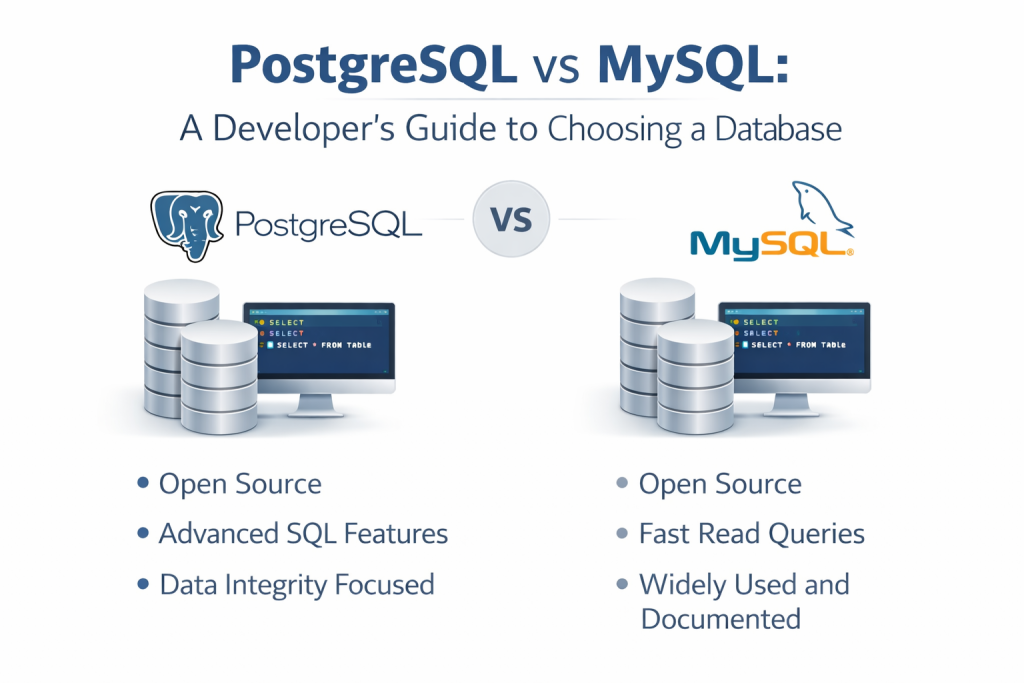
In the tech landscape of 2026, the choice between MySQL and PostgreSQL is no longer just about which one is “faster.” With the explosion of AI-native applications and the need for complex data types, developers are asking deeper questions. Should you stick with the battle-tested reliability of MySQL, or do you need the “advanced” extensibility of PostgreSQL? At Gotmyhost, we support both on our high-performance infrastructure. This guide will help you decide which one belongs in your stack.
MySQL: The Reliable Speed King
MySQL has long been the backbone of the web (powering WordPress, Magento, and Shopify). In 2026, it remains the go-to choice for read-heavy applications where simplicity and vertical scaling are the priorities. MySQL is also open source, although heavily supported by Oracle. While MySQL boasts broad functionality, it offers fewer features than Postgres, helping to make it a more “lightweight” tool.
Why Developers Choose MySQL:
- Simplicity & Speed: For straightforward web applications (CMS, Blogs, E-commerce), MySQL’s read speeds for simple queries are still top-tier.
- Ease of Management: It is generally perceived as easier to configure and maintain for teams without a dedicated Database Administrator (DBA).
Massive Ecosystem: Being the world’s most popular open-source database means you will never run out of community support or compatible third-party tools.
PostgreSQL: The AI & Logic Powerhouse
PostgreSQL, or Postgres, is a relational database management system (RDBMS) commonly used to store and retrieve tabular data organized in databases and tables. PostgreSQL is often called “The World’s Most Advanced Open Source Database.” Postgres is compatible with all major operating systems and supports a number of extensions and plugins. In 2026, it saw a massive surge in popularity because it handles complex logic and AI vector data better than almost anything else.
Why Developers Choose PostgreSQL:
- Extensibility (The AI Edge): With the “pgvector” extension, PostgreSQL has become the favorite for developers building AI apps that need to store and search “vector embeddings.”
- Complex Queries: If your app involves intricate “JOINs,” deep analytical reporting, or massive datasets, Postgres’s sophisticated query planner will outperform MySQL.
Data Integrity: Postgres adheres strictly to SQL standards and is “ACID compliant” out of the box, making it the safer choice for fintech and healthcare applications.
Choosing Between PostgreSQL and MySQL
We’ve thoroughly explored the basics of Postgres and MySQL, discerned their similarities and differences, and explored their more complex features and functionality. Now, it’s time to choose the right tool to tackle your data project.
Below are several scenarios and the tool best suited to tackle each of these challenges:
| Use case | PostgreSQL | MySQL |
| Large-scale enterprise applications | Excellent, with robust scalability and complex query support | Good, but better suited for lightweight tasks |
| Applications requiring geospatial data support | Ideal (PostGIS support) | Basic support |
| JSON and NoSQL-like data support | Strong (supports JSON and JSONB types) | Limited (basic JSON support) |
| High read performance (e.g., web apps) | Decent, but not as optimized for reads | Excellent (InnoDB engine, row-level locking) |
| Complex, concurrent read-write operations | Superior (multi-version concurrency control) | Good, but it may experience locking issues |
| Easy setup for small web projects | Takes longer to configure | Fast and easy to set up |
| Data warehousing and analytical processing | Excellent, with powerful indexing and parallel queries | Decent, but lacks advanced features |
Ecosystem and tooling
Both PostgreSQL and MySQL come with rich ecosystems supported by a wide range of tools, extensions, and third-party integrations, making them highly versatile for different use cases. Here’s an overview of some of the most popular tools available for each:
PostgreSQL ecosystem:
- pgAdmin: One of the most widely used management tools for PostgreSQL, pgAdmin offers a powerful graphical interface for managing databases, running queries, and administering users. It’s highly extensible and supports all PostgreSQL features.
- PostGIS: A robust extension that enables support for geospatial data in PostgreSQL, making it ideal for applications requiring geographic information systems (GIS). PostGIS is used in logistics, urban planning, and environmental monitoring industries.
- TimescaleDB: Built on top of PostgreSQL, TimescaleDB enhances PostgreSQL’s capabilities for handling time-series data. It’s widely adopted in fields like IoT, finance, and monitoring systems.
- pgBackRest: A backup and restore tool designed for PostgreSQL, offering advanced features like parallel backup and restore compression and encryption.
MySQL ecosystem:
- MySQL Workbench: This comprehensive tool provides a unified interface for designing, developing, and managing MySQL databases. It supports database modeling, SQL development, and migration tasks.
- Percona Server for MySQL: A free, enhanced, and fully compatible version of MySQL, offering better performance and scalability. Percona Server also includes advanced performance tuning and observability features, making it ideal for production environments.
- Oracle Enterprise Manager: Oracle offers extensive support for MySQL through its Enterprise Manager tool, which provides monitoring, management, and security features for enterprise use cases.
phpMyAdmin: A popular web-based interface for managing MySQL databases, phpMyAdmin simplifies database management, especially for smaller projects or individual developers who need quick access to queries and database structure.
The Decision Matrix
Still undecided? Use this quick checklist to see where your project lands.
Choose MySQL if…
- Read Speed is Vital: Your site is a content platform where millions of users read data, but only a few write it.
- Simple Infrastructure: You want a database that “just works” with standard managed hosting.
- WordPress/Standard CMS: You are using a platform that was built specifically to run on the MySQL/MariaDB ecosystem.
Choose PostgreSQL if…
- AI Integration: You are building an app that uses LLMs and needs to store vector embeddings.
- Complex Data Types: You need to store Arrays, Geometric data, or custom objects.
- Strict Integrity: You are handling financial transactions where even a tiny data inconsistency is a disaster.
Write-Heavy Loads: Your application has thousands of users writing data simultaneously.
Performance on Gotmyhost
Whether you choose the speed of MySQL or the power of PostgreSQL, the underlying hardware matters. At Gotmyhost, we optimize our environment for both:
- NVMe Storage: Both databases benefit from our ultra-fast drives, reducing I/O wait times to near zero.
- One-Click Deployment: Our control panel allows you to spin up either database in seconds.
- Automated Backups: We provide point-in-time recovery for both, ensuring your data—no matter the format—is always safe.
The “best” database is the one that fits your current project requirements while allowing for future growth. If you are building a modern, data-rich application or something involving AI, PostgreSQL is the forward-thinking choice. If you are launching a fast, reliable web store or site, MySQL remains the undisputed king of the web.
Need help migrating your database to Gotmyhost? Our support team is skilled in both MySQL and PostgreSQL migrations to ensure zero downtime during your move.
Related Topic: How to Manage MySQL Database from cPanel