

Hypervisor technology is a fundamental element of modern virtualization. These tools are utilized by individuals and organizations looking to consolidate server resources or run multiple environments independently of the host hardware. By ensuring centralized data management, comparing tools like Xen vs KVM has become debatable, often topping the list when searching for the best hypervisor solutions available today.
Historically, Xen debuted in 2003 under a general public license and quickly established itself as a premier virtualization platform for Linux. However, the landscape shifted in 2007 with the emergence of KVM, which presented a formidable alternative to Xen’s dominance.
As virtualization continues to evolve, the capabilities and responsibilities of these best free hypervisors are constantly expanding. Navigating these technical advancements to choose the right platform can be complex. This guide is designed to clarify that choice by providing a detailed Xen vs KVM comparison.
Ready to elevate your infrastructure with the best hypervisor technology? Visit Gotmyhost today to explore our high-performance VPS and Dedicated Server hosting solutions tailored for your business needs.
What are KVM and Xen
Kernel-based Virtual Machine (KVM) is an open-source software that turns a Linux server into a hypervisor. This virtualization solution allows a single server to be split into multiple Virtual Machines (VMs), each with its own isolated operating system environment. Many experts consider KVM to be the best bare-metal hypervisor for Linux-based infrastructures due to its native kernel integration.
Xen is a hypervisor that allows you to create, run, and control multiple virtual machines on the same host operating system at the same time. Xen can be set up using hardware virtualization extensions that turn it into a bare-metal type-1 server. For those looking for cost-effective enterprise solutions, both stand out as the best free hypervisors in the market.
KVM is a type 2 hypervisor that leverages the Linux kernel features for virtualization and containers. Xen is a type-1 hypervisor, which means it controls all hardware, ports, and input/output (I/O) lines.
KVM vs Xen Architecture & Design
The fundamental difference in KVM vs Xen architecture discourse is simply about finding the best hypervisors, KVM or Xen.
KVM Architecture
KVM’s architecture is defined by its deep integration into the Linux kernel. By executing each virtual machine as a standard Linux process, it leverages the kernel’s sophisticated scheduling and security. This makes it one of the best free hypervisor options for those who want a clean, efficient, and maintainable design.
This integrated approach yields a design that is exceptionally clean, efficient, and maintainable. In any rigorous KVM vs Xen comparison, the structural simplicity and architectural elegance of the KVM framework are clearly distinguished.
Xen Architecture
Unlike KVM, the Xen architecture utilizes a sophisticated microkernel design. It functions as a minimalist software layer positioned directly atop the physical hardware, mediating between the host resources and the virtual environments. This lean layer delegates hardware control and driver management to a highly privileged management domain known as Dom0.
In this model, all subsequent virtual machines operate as DomUs—standard, unprivileged guest environments. Xen further distinguishes itself by offering two distinct operational modes: Hardware Virtual Machine (HVM) and Paravirtualization (PV). This dual-mode capability provides administrators with the necessary flexibility to optimize virtualization based on specific workload demands and performance requirements.
When evaluating KVM versus Xen architectures, it becomes evident that KVM emphasizes structural simplicity and streamlined kernel integration, whereas Xen prioritizes robust security through rigorous domain isolation. Consequently, the decision-making process hinges on whether an enterprise environment values architectural elegance or the enhanced protection afforded by specialized isolation layers.
KVM vs Xen Performance: Who Offers Superior Performance?
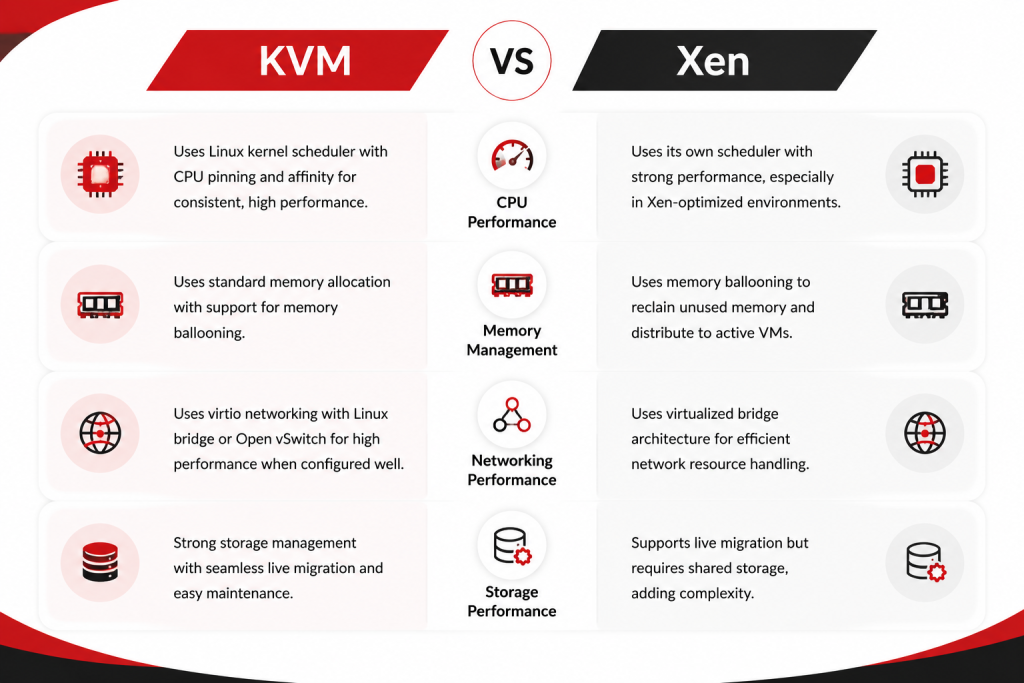
Selecting the optimal hypervisor often hinges on a direct comparison of performance metrics, particularly regarding I/O throughput and CPU utilization under various loads. This section provides an analytical review of KVM and Xen capabilities to determine which platform delivers superior speed and efficiency for diverse virtualization requirements.
CPU Performance
Regarding CPU performance, both KVM and Xen facilitate virtual machine execution with near-native efficiency. Discrepancies in performance typically emerge from specific workload characteristics and the intricacies of host scheduling mechanisms:
- KVM leverages the advanced Linux kernel scheduler and frequently incorporates CPU pinning and affinity configurations within various virtualization stacks. This integration ensures that CPU-bound workloads maintain high levels of consistency and performance stability.
- Conversely, Xen employs its own sophisticated scheduling controls, delivering robust performance that is particularly pronounced in environments meticulously optimized for the Xen architectural model.
Memory Management
- A further significant distinction between these virtualization methodologies lies in their respective memory management frameworks. KVM utilizes a conventional memory allocation model, wherein each virtual machine is assigned a discrete virtual address space that is mapped directly to the host’s physical memory.
- Xen facilitates memory ballooning, a dynamic technique that enables the hypervisor to reclaim underutilized memory from idle virtual machines and redistribute it to more active guests. While KVM also incorporates support for memory ballooning, the underlying implementation and orchestration nuances vary between the two platforms. Empirically, the adoption of ballooning can significantly enhance aggregate memory efficiency and optimize system-wide performance in environments characterized by volatile virtual machine workloads.
Xen can be efficient in environments that benefit from dynamic memory management, while KVM is often straightforward and stable under typical server loads.
Networking Performance
The architectural divergence between KVM and Xen further extends into networking performance, where distinct implementation methodologies significantly influence data throughput and latency:
- KVM utilizes the virtio networking framework in conjunction with Linux bridging or Open vSwitch. When meticulously configured, this combination delivers exceptional performance by minimizing the overhead associated with virtualized network stacks.
- Xen implements a virtualized bridge architecture that aggregates all virtual machines onto a single bridge interface. This centralized approach often results in superior networking efficiency, as the hypervisor can more effectively orchestrate the utilization of available network resources.
Storage Performance
Regarding storage performance, KVM and Xen demonstrate comparable metrics, as both platforms fundamentally leverage the same underlying physical infrastructure. However, nuanced discrepancies arise within their respective storage management frameworks:
- KVM distinguishes itself by offering robust storage management capabilities, specifically supporting the seamless live migration of virtual machines across hosts. This functionality facilitates more efficient load balancing and simplifies host maintenance procedures without necessitating downtime.
- While Xen also accommodates live migration, the process typically necessitates the implementation of a shared storage environment. This requirement can introduce additional complexity regarding both the initial deployment and the ongoing administrative overhead.
Ultimately, storage performance characteristics are seldom the deciding factor in hypervisor selection unless the specific virtualization environment is heavily biased toward the specialized tooling or architectural preferences of a particular ecosystem.
Pros and Cons Summary
A comprehensive summary is presented here, condensing the comparative insights into core strengths and limitations. This overview is designed to facilitate an informed, objective decision on the optimal hypervisor selection for specific enterprise demands.
| Category | KVM | Xen |
| Compatibility | Very strong for unmodified guests | Strong, but PV/HVM choices can affect compatibility |
| CPU Performance | Near-native; benefits from Linux scheduling | Near-native; strong with correct scheduler/tuning |
| Memory Features | Standard Linux model; can be very stable | Efficient reclaim/ballooning options in many setups |
| Networking | Excellent with Virtio + Linux networking stack | Strong; it depends on the driver and the bridge model |
| Security Model | Leverages the Linux security ecosystem | Strong isolation-focused architecture |
| Best Fit | General-purpose virtualization, broad OS support | Environments aligned with Xen’s model and tooling |
KVM vs Xen: Stack Up in Hardware Integration
Hardware compatibility is also an important area of consideration in the KVM–Xen comparison.
KVM Hardware
KVM’s hardware integration is significantly bolstered by its native presence within the Linux kernel, allowing it to seamlessly inherit a comprehensive and robust driver ecosystem. This architectural synergy ensures compatibility across an extensive range of server platforms, network interfaces, and specialized accelerators, including GPUs and storage controllers.
Ultimately, the breadth of KVM’s hardware support is directly proportional to the kernel’s capabilities, ensuring reliable performance and stability across diverse infrastructure environments.
Xen Hardware
Xen also maintains a comprehensive hardware compatibility profile; however, given its multi-layered microkernel design, driver accessibility remains fundamentally contingent upon the specific Dom0 implementation. By delegating hardware orchestration and driver management to the Dom0 domain, typically a robust Linux distribution, Xen ensures broad support across modern infrastructure. While Xen effectively interfaces with contemporary server hardware, akin to Hyper-V, its architectural framework introduces nuanced variables that can occasionally result in compatibility discrepancies.
When evaluating KVM versus Xen from a purely architectural perspective, KVM’s kernel-native structure affords it a definitive advantage in seamless hardware integration, whereas Xen’s sophisticated microkernel separation is meticulously orchestrated within a more rigorously controlled environment.
Licensing Costs and Efficiency: Minimizing Operational Load
Parallel to KVM, Xen operates as an open-source hypervisor, effectively eliminating the requirement for licensing fees associated with the underlying virtualization engine. Consequently, the KVM vs Xen economic discourse remains straightforward; both platforms deliver enterprise-grade virtualization while bypassing the substantial costs of commercial licensing. Operational expenditures are instead dictated by selected support frameworks, the requisite learning curve for management utilities, and the specialized expertise of the administrative team.
The preponderance of enterprise Linux distributions integrates KVM as a native hypervisor, often accompanied by comprehensive commercial support options. Xen’s architectural model—while highly robust—frequently necessitates a more profound technical understanding, potentially escalating operational overhead through specialized training requirements or the need for more experienced personnel.
Ultimately, within the KVM–Xen comparative framework, both hypervisors represent exceptional fiscal value for modern infrastructure deployments.
Which Is Easier to Manage?
In the context of long-term infrastructure efficiency, operational simplicity is a decisive factor for enterprise environments. The management comparison between KVM and Xen reveals distinct philosophical and technical approaches to virtualization orchestration.
Many system administrators favor KVM for its inherent intuitiveness, which stems from its native integration within the Linux kernel. By treating virtual machines as standard Linux processes, KVM allows teams already proficient in Linux administration to leverage familiar utilities and established management frameworks. Tools such as libvirt, Cockpit, and oVirt further streamline this experience, enabling seamless orchestration without requiring a significant departure from standard operational workflows.
The Xen architecture typically demands a more specialized understanding of virtualization theory to navigate its sophisticated microkernel design. Effective management of a Xen environment involves mastering the complexities of the privileged Dom0 management domain, unprivileged DomUs, and the split-driver model that characterizes its I/O architecture. While this model provides substantial architectural value, particularly through its robust security-focused isolation, it often necessitates a higher level of technical mastery from the infrastructure team. Organizations choosing between these hypervisors must therefore conduct a rigorous assessment of their internal technical expertise to ensure the selected platform aligns with their team’s operational capabilities.
Ultimately, the ease of management is subjective and tied to the existing ecosystem. KVM offers an evolutionary path for Linux-centric organizations, whereas Xen provides a specialized, isolation-centric environment that rewards those willing to invest in its unique operational requirements.
Choosing the Superior Hypervisor
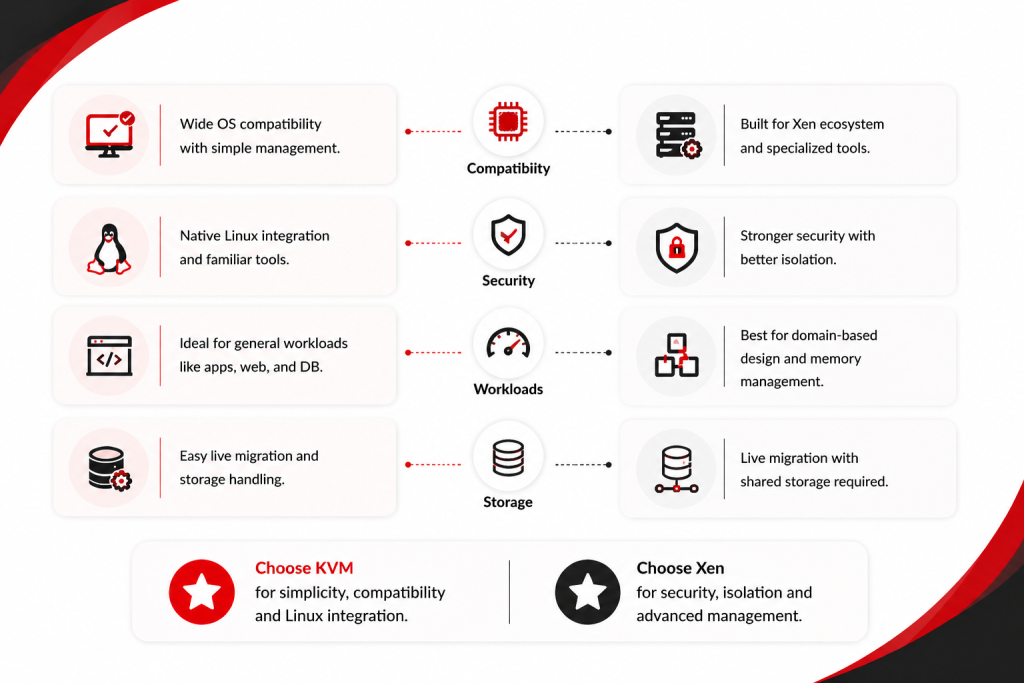
The organization’s primary infrastructure is the main factor in deciding between KVM and Xen hypervisors. Other deciding factors include UX, staff knowledge, and code requirements.
Admins should have a good understanding of current dependencies with specific vendors and a clear vision of where their IT projects are heading.
Choose KVM when –
- Your infrastructure requires extensive guest operating system compatibility while maintaining architectural simplicity and reduced administrative complexity.
- You prioritize seamless synchronization with the native Linux driver ecosystem and established management utilities to leverage familiar operational workflows.
- Your organization manages general-purpose workloads encompassing web services, applications, and databases, and you value the stability inherent in a mature virtualization ecosystem.
Choose Xen when –
- Your current infrastructure is meticulously optimized for the Xen ecosystem, specifically leveraging XenServer-based stacks or specialized orchestration tooling.
- You prioritize the robust security and isolation afforded by Xen’s sophisticated architectural separation and its specialized operational framework.
- Your enterprise workloads derive significant benefits from Xen’s unique domain-based design or its advanced methodologies for dynamic memory management.
The most pragmatic methodology for navigating the KVM versus Xen selection involves meticulously aligning the hypervisor’s capabilities with specific enterprise operational mandates and localized workload profiles.
Within the broader KVM versus Xen performance discourse, no singular platform emerges as an absolute victor; when meticulously optimized, both hypervisors demonstrate exceptional efficacy across CPU utilization, memory management, and high-throughput networking and storage infrastructures.
Ultimately, the defining distinctions are rooted in architectural philosophy, management tooling, and strategic operational alignment. Organizations prioritizing extensive guest compatibility and seamless Linux kernel integration frequently identify KVM as the optimal solution, whereas those deriving value from rigorous architectural separation and the Xen-specific orchestration model will find Xen to be a sophisticated alternative.
Read more: KVM vs ESXi: Key Features To Choose the Right Hypervisor for Your Infrastructure
Frequently Encountered Hypervisor Deployment Questions
This section addresses the most critical and recurring technical questions surrounding the deployment, architectural nuances, and operational management of both KVM and Xen hypervisors.
What Is The Primary Architectural Distinction Between KVM and Xen?
KVM is deeply integrated as a native module within the Linux kernel, operating as a Type 1 hypervisor that treats virtual machines as standard Linux processes. Xen utilizes a microkernel design, where a minimal layer sits on the hardware, delegating resource and driver management to a privileged control domain (Dom0).
Are There Licensing Costs Associated With Deploying KVM or Xen?
No, both are among the best free hypervisor options available under open-source licenses, which effectively eliminates the requirement for commercial licensing fees for the core virtualization engine. Operational costs are instead focused on support, management utilities, and administrative expertise.
Which Hypervisor Is Generally Considered Easier For Linux System Administrators To Manage?
KVM is often favored for its inherent intuitiveness, as its native integration within the Linux kernel allows administrators to leverage familiar utilities and established management frameworks (like libvirt and oVirt). Xen’s sophisticated microkernel design typically demands a more specialized understanding of virtualization theory and mastery of the privileged Dom0 management domain.
Is KVM Faster Than Xen?
It depends on the workload and configuration. In many modern environments, performance is comparable, and differences come from tuning, drivers, and storage/network backends rather than the hypervisor alone.
Which Hypervisor Is Better For VPS Hosting?
Both are widely used for VPS hosting. KVM is often chosen for broad compatibility and Linux integration, while Xen is common in environments that standardize on Xen-based stacks and operational tooling.
Defining the Optimal Hypervisor Selection
In Xen vs KVM, both KVM and Xen represent high-performance hypervisors engineered within the C programming language framework.
The core differentiation between these platforms lies in their architectural foundations: KVM operates as a sophisticated virtualization module within the Linux kernel, whereas Xen functions as a native type-1 hypervisor designed to orchestrate multiple concurrent operating systems directly on physical hardware. KVM and Xen deliver substantial architectural advantages, specifically the capacity to consolidate disparate operating systems onto unified physical infrastructure while enhancing network agility. Ultimately, the strategic selection of a hypervisor is contingent upon an organization’s foundational infrastructure, the specialized expertise of its administrative personnel, and its long-term cloud integration objectives.
Furthermore, enterprises deploying KVM- or Xen-based virtualization must acknowledge that these environments remain susceptible to ransomware excursions and unforeseen catastrophic events. Consequently, implementing a robust data protection and disaster recovery solution, such as Storware, becomes an essential mandate for operational resilience.
To transition from this strategic analysis to implementation, ensure your hypervisor selection is deployed on a foundation of high-performance, scalable infrastructure. Gotmyhost provides optimized VPS and Dedicated Server solutions designed to support maximum virtualization efficiency and guarantee business continuity.